I found my way to Unitarian Universalism because of a deep moral imperative I felt to speak out against the genocide of the Palestinian people.
I had traveled to Palestine as a divinity school student in 2014, and witnessed the incredible hospitality and deep faith of the people there, as well as the deliberate cruelty of the apartheid system that they live under. But like most people living outside of Israel/Palestine, the destruction of Gaza, as author Peter Beinart terms it, still shocked me to my core.
I was directing the children’s program at a Christian church when the world began to witness the Israeli military’s indiscriminate murder of Palestinian civilians in 2023. That Christmas I sent a letter to the families I worked with, pleading with all the conviction of my sincerely held Christian faith that our Christmas celebrations would be meaningless if we did not stand up to protect the children who were suffering and dying in the birthplace of Jesus.
I did not speak about Palestine directly in our Sunday worship services until the Lenten season of the following year. I was waiting to follow the lead of our ministers, who remained silent on the issue, even while privately expressing sympathy with my perspective. When my soul became overburdened with grief and anxiety around this silence, I said a simple prayer one Sunday morning: “God, please protect the children of Gaza, who will be spending Lent and Ramadan in unsafe places, and help us to bring an end to this unjust war.”
Without telling me about it, our senior minister had this prayer edited out of the video of our livestreamed service that was posted online.
To make a long and emotionally fraught story short, I resigned from my position when it became clear to me that avoiding controversy in order to protect the institution would continue to be prioritized over doing what Jesus commanded his followers to do: to care for “the least of these,” the powerless and oppressed people of the world.
Losing my job barely registered for me in the crisis of faith that ensued. I wish I was able to write off this particular congregation as uniquely corrupted, but as the months passed and the death toll increased, and when no one could plausibly deny the evidence of Palestinian children’s emaciated, brutalized, and dismembered bodies seen clearly through the screens of our phones, the near universal silence and apathy of liberal Christians finally did what a childhood in conservative fundamentalism couldn’t achieve – it permanently alienated me from the Christian church.
I resigned myself to finding a new vocation, my Master of Divinity degree now seemingly useless. But right at that time, the DRE job opened up at the UU Congregation of Santa Monica, and I found that my calling to speak out for Palestine did not disqualify me at UUSM. On the contrary, people who heard my story told me that they admired my courage and moral clarity. I don’t say this to pat myself on the back – I think my actions cleared an extremely low ethical bar – but to encourage others who fear they may be rejected for affirming Palestinian humanity.
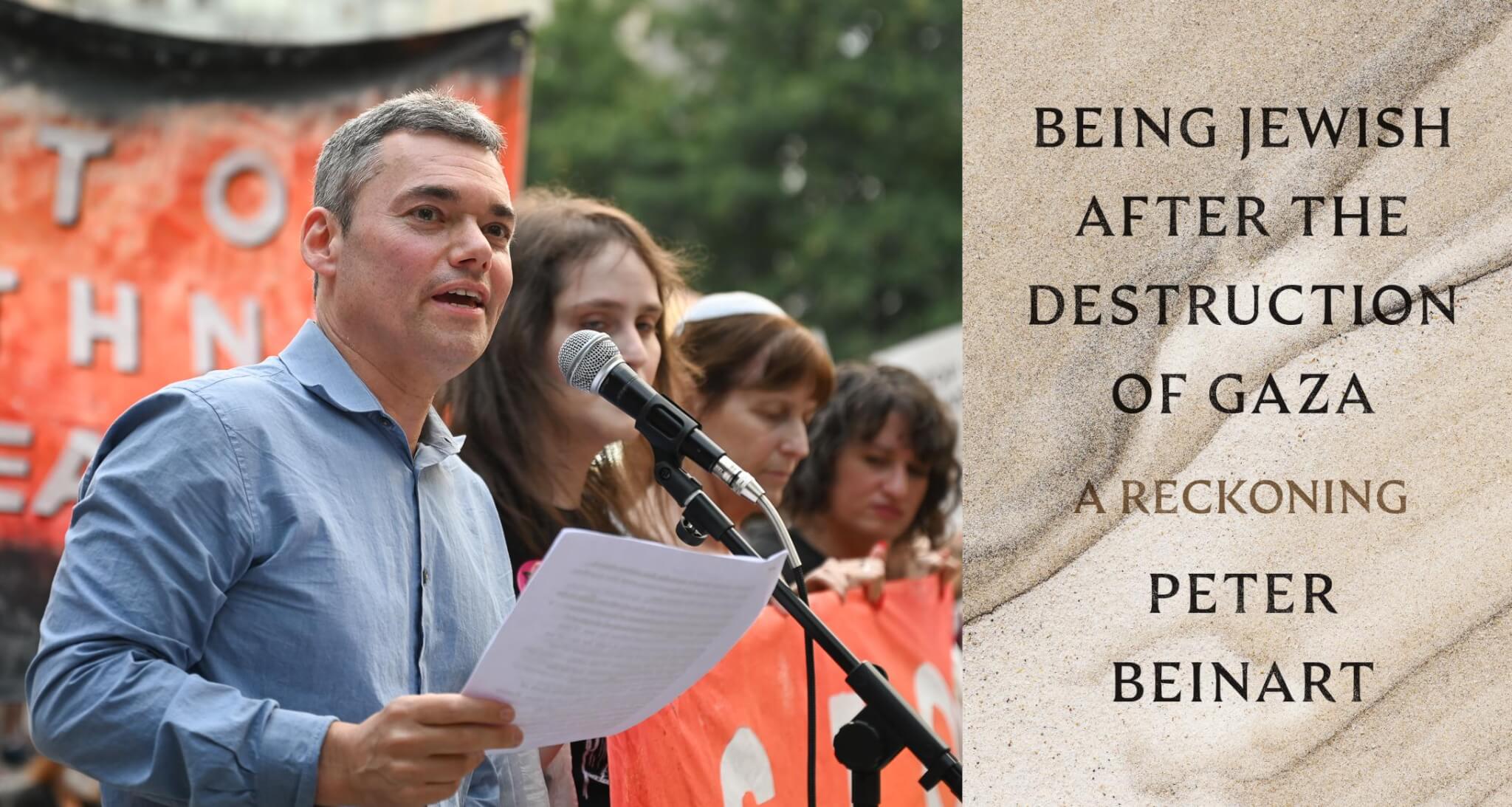
The commonly stated justification for censorship or persecution of advocates for Palestine, both in my own experience and among the activists who risked and suffered far more than I ever did, is sensitivity to antisemitism. I could write endlessly about the error of this fallacy – but Peter Beinart is one of the Jewish writers who has already addressed it with more clarity, brevity, and sensitivity than I ever could. I selected Being Jewish After the Destruction of Gaza for our congregation to explore together (over two sessions on March 22 and 29), because it is a brief, accessible, and pastorally sensitive work by a Jewish author addressed to a Jewish audience. Beinart’s slim and readable book gets to the heart, I believe, of what makes so many Americans –
Jewish or not – afraid to speak out against the atrocities that are still being committed by the state of Israel.
Beinart understands these fears intimately, and speaks to the heartbreaking alienation from his friends, family, and faith community that have resulted from his words. But he writes from a place of deep love for those friends, family, and faith, which he longs to liberate from patterns of thought that, in his words, “have justified the destruction of an entire society.” His book makes room for readers at any starting point, from enthusiastic support of the Israeli state to strident opposition, and invites every reader towards greater empathy for the other.
I’m entering into the conversation with this bias: criticism of the Israeli state is not antisemitic; on the contrary, conflating the ancient, rich, and diverse tradition of Judaism with the Israeli state is a doorway to the very antisemitism that is becoming increasingly common in our public discourse. While some opportunistic antisemites certainly attempt to spread their hatred through the Trojan horse of anti-Israel sentiment, they should not be allowed to define the anti-apartheid and anti-genocide movements, which are so strongly rooted in the values of equity, pluralism, justice, and love that Unitarian Universalists claim.
You may be coming to this conversation with a very different set of biases. In being transparent about my own, I invite everyone who participates in this discussion to be honest about where they stand, and for all of us to meet each other with a listening ear, a generous spirit, and the assumption of good intentions. My greatest hope for this group is to draw in a diversity of perspectives, to hold space for meaningful, emotionally mature conversations, and for all of us to leave with hearts more open to love and truth than they were before. That has always been my prayer.
If you would like to participate in the Adult RE book discussion group on Being Jewish After the Destruction of Gaza: A Reckoning on Sunday, March 22nd and 29th, 1-3 pm, email Jessica
at dmre@uusm.org to RSVP!
Peter Beinart photo used above is by Gili Getz, CC BY 4.0, via Wikimedia Commons