Reflections by:
• Charles Masten
• Jessica TenHave-Place
• Judith Martin-Straw
 Our Fourth GA was Spiritually Energizing
By Charles Masten
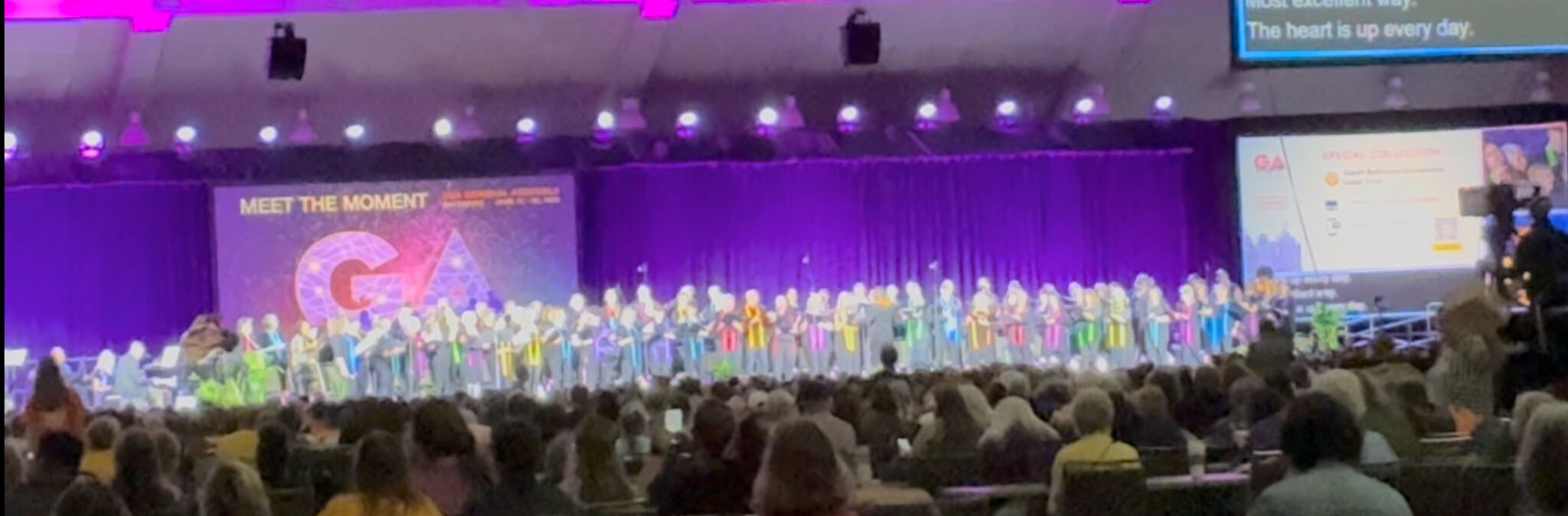
I served as a delegate from UUSM to the Unitarian Universalist Association General Assembly which was held in Baltimore Maryland June 18-22, 2025. This is my “report-back” to the church Community.
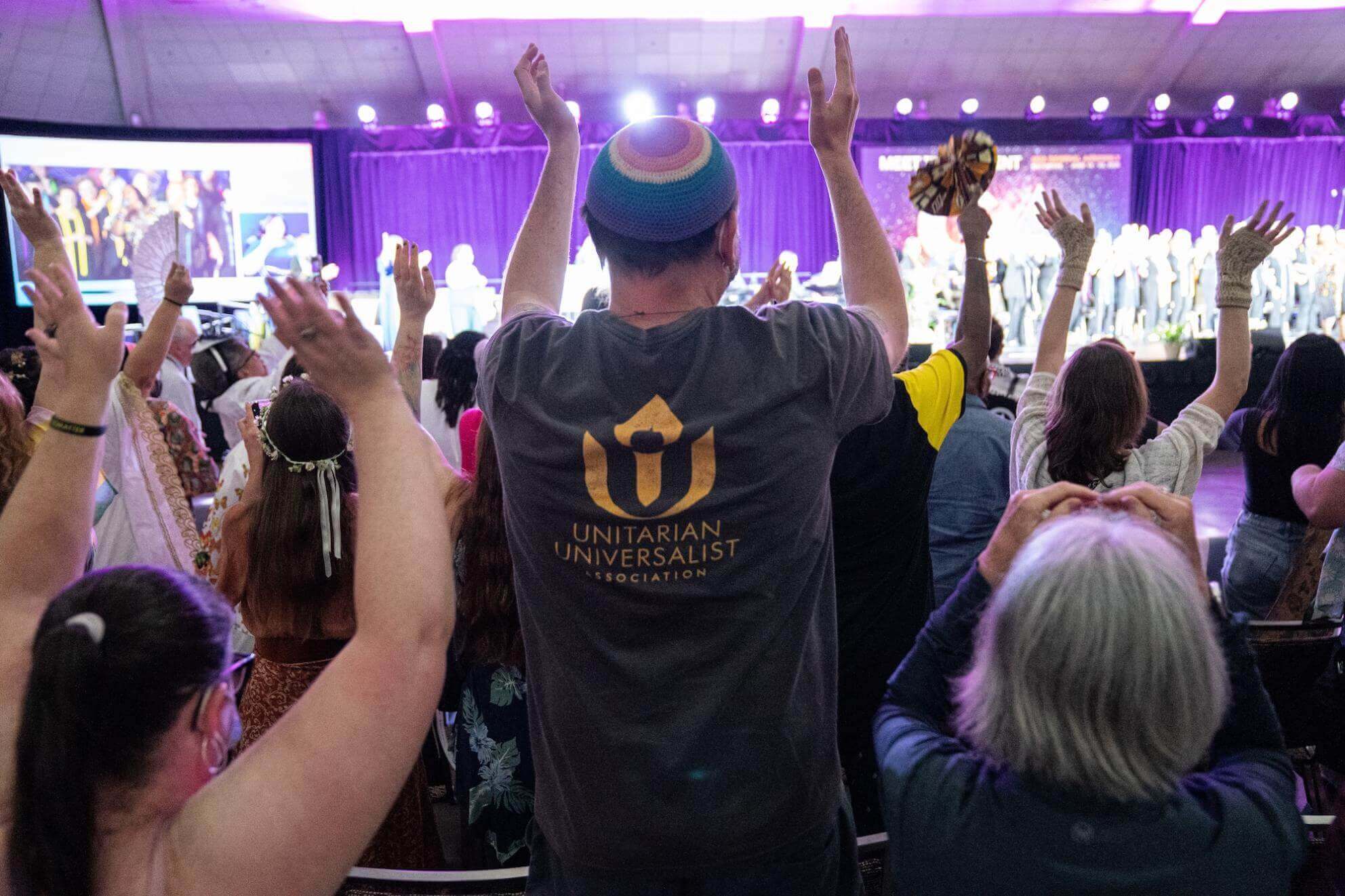
The UUA’s General Assembly (GA) consists of daytime workshops, afternoon “sessions” where delegate business occurs, big evening events, an exhibit hall with a wide variety of UUA and other organizations and vendors, and worship. About 3,000 folks showed up in person with more on-line. Contributions from on-line participants were woven throughout. There were about 1,100 delegates that voted. Also representing our church were DMRE Jessica TenHave-Place, Judith Martin-Straw, Elle Long, and Lauren Poole.
The GA theme was “Meet the Moment.” I attended a series of signature workshops considering the current moment with a general focus; other workshops focused on worship or fundraising. In my sessions, each day started with a grounding question. Some of my impressions follow.
Day 1. What is the moment? Ongoing damage to migrants, people of color, LGBTIQ especially Trans, democracy, funding losses.
Day 2. What are the most urgent and important needs and opportunities in this moment? Humanize everybody/combat dehumanization, safety especially for our LGBTIQ and migrant siblings, solidarity.
Day 3. How are our UU values calling us to respond to this moment? Individual responses will vary. Collectively UUs should not cede the religion ground in public discourse. Be out and proud about having a religion and engage in the “narrative space,” where white Christian Nationalists currently dominate, by telling our stories assertively.
The 102nd Ware Lecture* was delivered by Imara Jones, a journalist and trans rights activist. She described how the Heritage Foundation tested potential wedge issues and chose trans rights because it unites the right and splits the left, such as “I’m just not comfortable with trans people” sentiments among some liberals. She urged us to not get caught in this Heritage Foundation wedge and live up to our UU values by actively supporting trans rights. She was a powerful voice for justice and love.
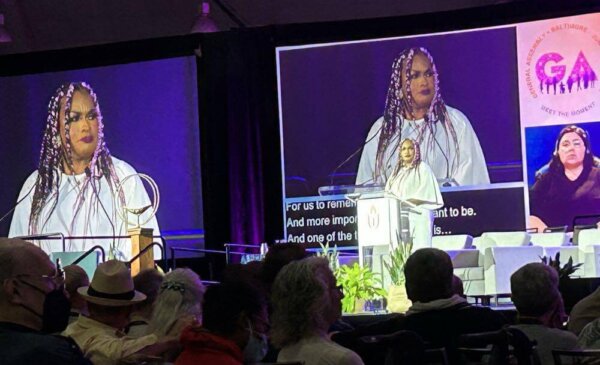
* prior lecturers include Martin Luther King, Jr, Reinhold Niebuhr, Shirley Chisholm, Naomi Klein, and many other luminaries.
Votes were mostly procedural. A new team of Co-Moderators was elected for a five year term. We adopted three Actions of Immediate Witness:
1) We Declare and Affirm: Immigrants are People who have Inherent Worth and Inalienable Rights
2) Faithful Defiance of Authoritarianism, a Call to Action: Reaffirming Our Covenants for Democracy and Freedom!
3) Defending LGBTIQ+ Freedom Amid Funding Crisis: A Call for Global Solidarity
Each of these has a dedicated and energetic team behind it. The Assembly selected “Abolition, Transformation, and Faith Formation” (re mass incarceration) as the UUA’s next Congregational Study/Action Issue (CSAI), also with a dedicated and energetic team.
Odds and ends: UU the Vote was held up as an example of “distributed organizing” and is now one of the most successful programs of the UUA. Expect more of this model from the UUA. A panel of UUA senior executives talked about how the UUA looks at data among other topics. The execs were young (30s and 40s), and impressive. “We should stop focusing on unending growth, instead think of cycles.” “Parents are not coming to save our congregation, they need us to save them.”

Besides GA, Lauren and I enjoyed our time in Baltimore eating crabs, taking a harbor cruise, and hanging out in a crowd of UUs. This was our 4th GA and it always leaves me spiritually energized.
The next in-person GA will be June 23-27, 2027 in San Jose, California.
My First UUA General Assembly
By Jessica TenHave-Place
I was thrilled to be able to make the trip out to Baltimore for my first ever UUA General Assembly. I wasn’t sure exactly what to expect beyond what was listed on the schedule, but what I found there was not only education and democracy in action among UUs from all over the country (see Charles Masten’s article above for a good summary of this year’s highlights), but a deep spiritual camaraderie with people who I had never met.
I connected with lots of fellow UUs and other Religious Educators who shared my passion for social justice issues like LGBTQ liberation, ending the genocide in Palestine, and human rights for immigrants. We shared our experiences, brainstormed new ideas for what might work in our communities back home, and spoke from our hearts about how standing up for justice is intrinsic to our faith. Being from Los Angeles was a good conversation starter – UUs all over have witnessed immigrants and citizens alike being terrorized by ICE on the news, and it was a privilege to share my own experience of standing against these attacks with my friends and neighbors.
I also heard great stories about the diverse ways UU congregations are thriving in our tumultuous times. From our neighbors at First Unitarian LA providing a home for local activism and community services in their lay-led congregation, to The Community Church of New York on the other side of the country reaching people through a “Ministry of Yes” that empowers people to pursue new ideas without getting stuck on “the way we’ve always done things,” I was inspired to see the magic that happens when UUs are led by our values and a genuine desire to meet the needs of the people around us.
My favorite moment at GA sums up something I love about Unitarian Universalism. I attended the worship service organized by CUUPS (Covenant of Unitarian Universalist Pagans) in an overflowing room filled by people of all ages, where we grounded our breath in the elements of nature, sang together, and spilled out into the lobby for an impromptu spiral dance. I was full of the joy of participating with my fellow UUs in pagan forms of spiritual practice, when I realized that the UU Christian Fellowship meeting next door had not yet concluded their worship service. I jumped in to take communion, receive a beautiful blessing, and sing some familiar childhood hymns.
“This is what’s so great about being a Unitarian Universalist!” I exclaimed to the minister who had prayed for me in the Christian service, a young woman from the east coast who is also engaged in advocacy for Palestine. “I don’t have to choose between being a Pagan or being a Christian – I can be both, and more!”
The 2025 General Assembly was a beautiful representation of this multiplicity – we all come from diverse spiritual backgrounds and practices, from different generations, from lifetimes spent in UU congregations to newcomers like me. All were welcomed, and while our tradition and heritage were proudly honored, there was no sense of the old being privileged above the new. This is a living tradition, moving in new and exciting ways, fired up to respond as fierce advocates for justice in an unjust world. Returning home, I felt the presence of all the people I had been with at GA – it’s wonderful to know that as we face so many challenges at home, we are not alone.
Feeling Community
By Judith Martin-Straw
I attended the GA in Baltimore as a volunteer, and so I did a great deal of observing in different spaces and listened to what was being discussed. It was a moment for connection, and a cautious optimism. What the General Assembly looks to do and what it actually does felt very close at this gathering, and it left me feeling that I was part of a group moving in a good direction.
Both the Fahs Lecture and the Ware Lecture gave some very dense food for thought.
The Fahs Lecture was focused on the Religious Exploration programs that work with our youth. A group of speakers took the podium to address the “soul work of community organizing.” The first speaker, Rev. Sean Neal-Barron of the Foothills Unitarian Church of Fort Collins, Colorado, shared his vision. Speaking from the perspective of a gay minister, active in the community, Neal-Barron spoke about offering blessings at a Pride event, and then being recognized in another setting later and questioned as to his identity. “Are you a real priest?” Being in a faith that fosters authenticity gives him the ability to encourage authenticity in others, particularly those just growing up into their own vision and version of themselves
Lauren Carter, also of Foothills spoke to the fact that “Organizing is messy, frustrating, and filled with partial wins, yet at its core, it’s soul work.” Katherine Childs, who serves All Souls Unitarian Church in Tulsa, Oklahoma, gave several examples of how the playful creativity we often associate with “Sunday School” can open the eyes of those at any age, by giving their hands a way to express their hearts. “We created a sign-making station, and we take it to all the protests.” It is a table-topped cart with drawers for art supplies, making them a required stop for those who had come without signage, allowing them both space to express their ideas and a moment to connect with the church. The emphasis on having open-minded, non-binary examples of church leaders for youth, particularly in red states, came with a call to sign up and be an example.
The Ware Lecture, given by Imara Jones, was a compact and powerful education in the use of propaganda to foster a political agenda. Jones has won both Emmy and Peabody Awards, is the creator of TransLash Media, a cross-platform, non-profit journalism and narrative organization, which produces content to shift the current culture of hostility towards transgender people in the US. She was named by Time Magazine as one of the 100 Most Influential People on the planet in 2023.
Offering her perspective and asking some insightful questions of the audience allowed her to shine a light on how transphobia has been used to polarize voters.
“How many of you think that 30% of the population is trans? How about 25% ? How many people think it’s 10%? In fact, trans people are less than 1% of the population. It’s comparable to the number of redheads in the room. But the Heritage Foundation started pushing this agenda a decade ago, trying to persuade voters that trans people are a threat, a problem, an issue. And it worked.”
The UU Global Worship service featured Rev. Zsolt Elekes, Juban Lamar, Carol Maciel, and Esther Mukera from other leaders from Transylvania, Brazil, India, Kenya, and the United Kingdom. Speaking about how the faith was expanding or diminishing in their part of the globe, it was a moment to remember how big this movement is, and how venerable it is as well.
The presentation of a new “virtual” hymnal was accompanied by many of the contributors offering their music to an enthusiastic and receptive crowd.
All the worship services offered insightful and inspiring sermons, and I was glad to be there. I’m happy to have the rest of the summer to catch up on the virtual offerings that I did not have time to attend – hours and hours of programming. I’ll sift through a few things, but I’m sure there are as many worthwhile sessions I missed as those I attended.
UUWorld article: Amit Tumultuous World Events, UUs at GA 2025 Vow to Meet the Moment